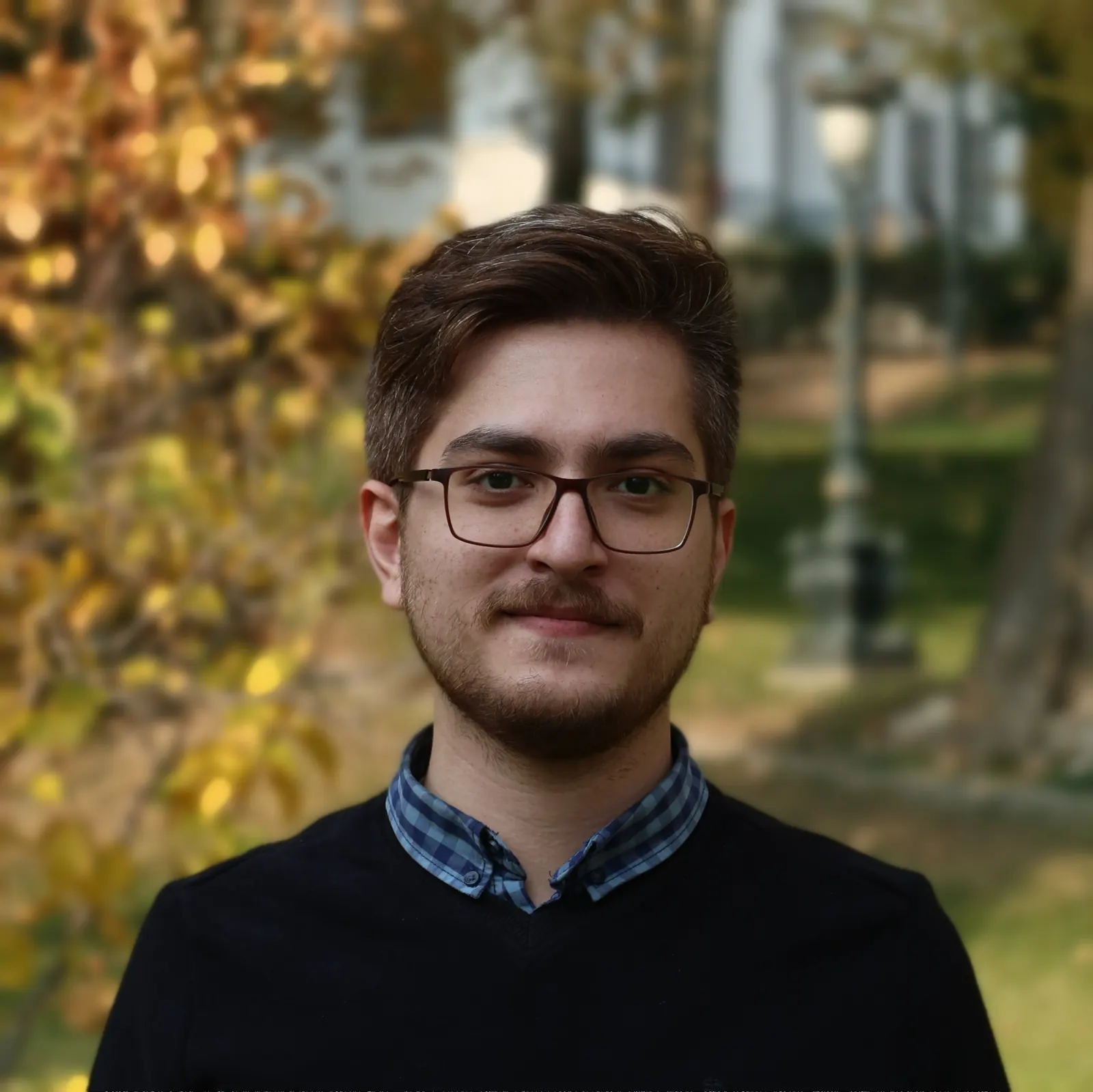
From my early years, I've been drawn toward the intricacies of computers and smart systems, captivated particularly by the application of AI in video games. This curiosity steered my academic trajectory toward Shahid Beheshti University, where I immersed myself in the study of computer science, data mining, computer vision, and deep learning.
Hey there, I’m Alireza
Alireza Azadbakht
AI Engineer & Data Scientist
I solve problems and develop things. An AI engineer and data scientist working on computer vision, Persian language technologies, and efficient deep learning for edge devices — always looking for out-of-the-box approaches to hard problems.
// Curiosity became craft.
A journey of growth
My Master's thesis, an ambitious endeavour to translate MRI images to CT scans using cutting-edge deep learning models like vision transformers and GANs, was met with academic acclaim, achieving the highest possible grade.
The professional arena was a seamless transition, thanks to my proactive approach during my academic years. I launched my career as a Data Scientist, specializing in medical data. Initial challenges, such as managing substantial data volumes and optimizing database queries, were surmounted, and these experiences fortified my analytical and technical capabilities.
As an AI Engineer, my work was marked by noteworthy contributions, including the development of a resource-efficient license plate OCR engine compatible with edge devices. Furthermore, I made significant strides in linguistic AI, developing a solution for Persian Handwritten OCR.
Currently, I am at the helm of a team of bright, junior data scientists, leading projects with a focus on the Persian language. My leadership has fostered a dynamic environment, conducive to creativity and precision in problem-solving.
I'm proud of my research contributions, with three publications under my belt by the end of my Master's degree. These include a paper on a vision transformer-based license plate OCR, another on kernel sharing on convolutional neural networks for optimizing deep learning models for hardware implementation, and a study on remote sensing and identifying agricultural field boundaries from satellite images.
However, my journey is far from complete. I am firm in my belief that AI holds the potential to revolutionize our world, and I am committed to being a part of this metamorphosis. My ultimate goal extends beyond personal recognition; I aspire to shape the next generation of AI researchers and leave an indelible mark on the world. My determination and passion will undoubtedly guide me in this endeavor.
// Selected work
Things I have built.
MultiPath ViT OCR — Persian license plate recognition
Published · DeployedA lightweight vision transformer for license plate OCR designed to run on edge devices with limited compute. To train it I gathered and annotated LicenseNet, a dataset of 1.3M Persian license plate images captured across different cameras, viewing angles, and day/night conditions.
- Accuracy
- 77.25%
- vs. CNN baseline
- +2.1 pts
- Trainable params
- 3.2× fewer
- PyTorch
- Vision Transformers
- CTC
- Edge inference
Inter-layer kernel sharing for deep CNNs
Published · Open sourceA method that shares convolution kernels between isomorphic layers to shrink a network's trainable parameter count without shrinking the network itself. Collaboration with CerCo (CNRS) and ANITI in Toulouse, evaluated on ConvMixer and SE-ResNet.
- Param reduction
- 13.4×
- Accuracy cost
- 1.8 pts
- Benchmarks
- CIFAR-10/100
- PyTorch
- ConvMixer
- SE-ResNet
- Model compression
MRI to CT image translation
Master's thesisDeep generative models for cross-modality medical image translation, synthesising CT scans from MRI inputs using vision transformers and GANs. Awarded the highest possible grade at Shahid Beheshti University.
- PyTorch
- GANs
- Vision Transformers
- Medical imaging
Thesis, Shahid Beheshti University · 2023
Cadastral boundary detection from satellite imagery
PublishedInstance segmentation with Mask R-CNN to automatically delineate agricultural field boundaries in very high resolution remote sensing images, reducing the manual effort in cadastral mapping.
- Mask R-CNN
- Remote sensing
- Instance segmentation
Persian handwritten OCR
Production · Closed sourceA recognition engine for handwritten Persian text, built at Irapardaz to handle the cursive, context-dependent letter forms that make Persian substantially harder than Latin-script handwriting.
- PyTorch
- Sequence modelling
- Persian NLP
Proprietary — available on request
YAKG — Yet Another Kerio GUI
Open sourceA native GNOME frontend for the Kerio Control VPN Client on Linux. It puts a desktop interface in front of the official CLI-only client: connect and disconnect, named profiles, tray integration, and notifications — without implementing the VPN protocol itself.
- Python
- GTK 4
- GNOME
- Linux
// Research
Peer-reviewed & preprints.
-
2022
MultiPath ViT OCR: A Lightweight Visual Transformer-based License Plate Optical Character Recognition
12th International Conference on Computer and Knowledge Engineering (ICCKE), IEEE
20citations -
2022
Drastically Reducing the Number of Trainable Parameters in Deep CNNs by Inter-layer Kernel-sharing
arXiv preprint arXiv:2210.14151
9citations -
2023
Automatic Cadastral Boundary Detection of Very High Resolution Images Using Mask R-CNN
arXiv preprint arXiv:2309.16708
4citations
Citation counts via Google Scholar, August 2026.
// Experience
Built through practice.
My journey into the world of technology began in earnest in July 2016 when I embarked on an exciting venture as a Freelance Software Developer. For a period spanning over two years until September 2018, I immersed myself in various projects, honing my skills and learning the nuances of the field.
Simultaneously, from January 2018 to June 2018, I had the privilege of serving as a Teacher Assistant at Shahid Beheshti University. There, I took part in the Advanced Programming (Java) course, assisting students and facilitating their learning.
During this time, I also embraced an opportunity to explore game development at Shahid Beheshti University's Cyberspace Research Center (CRC). I was tasked with the development of a Virtual Reality game for HTC VIVE using Unity3D, a project that allowed me to delve deeper into the fascinating world of VR and game design.
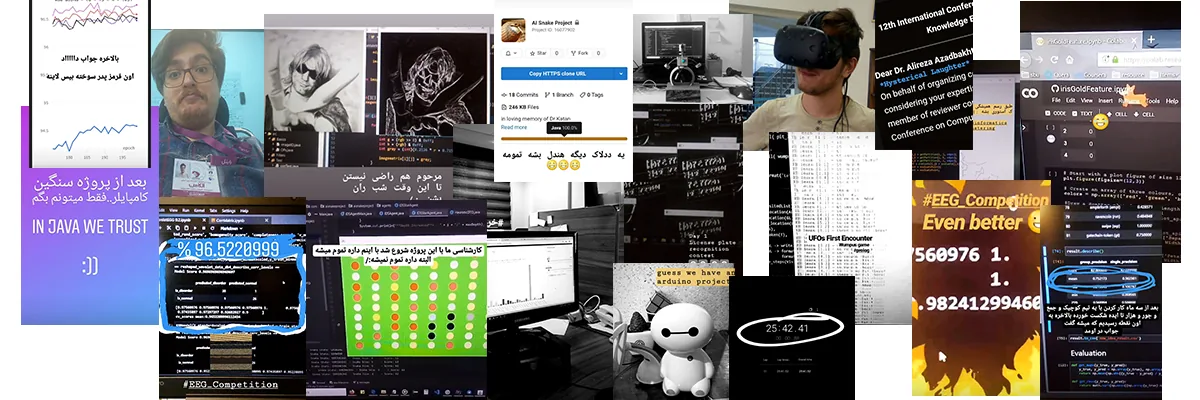
Seeking to broaden my horizons further, I embarked on an IT Internship at the Non-Communicable Diseases Research Center (NCDRC) in September 2018. Located in Tehran Province, Iran, I spent a year there learning and contributing to various IT-related projects. This internship paved the way for my subsequent role as a Data Scientist at the same organization from October 2019 to August 2020. This experience allowed me to delve deeper into the world of data, further enriching my technological expertise.
In tandem with my work as a Data Scientist, I returned to Shahid Beheshti University as a Teacher Assistant from October 2019 to March 2020. This time, I was involved in the Neural Networks course, a role that allowed me to both share and deepen my knowledge in this field of artificial intelligence.
The next chapter of my career journey began in May 2021 when I joined Irapardaz, a Tehran-based company. As a Team Lead and an Artificial Intelligence Engineer, I have been able to apply my accumulated skills and experiences in a leadership role, guiding a team of talented individuals while working on innovative AI projects. Over two years into my time at Irapardaz, my journey continues to be one of learning, growth, and contributing to the field of AI.
// Education
Mathematics to intelligent systems.
I began my academic journey at the National Organization for Development of Exceptional Talents, where I spent four years studying Mathematics. This foundation strengthened my analytical and problem-solving mindset.
In 2016, I enrolled in a Bachelor’s degree in Computer Science at Shahid Beheshti University, one of Iran’s leading institutions, where I immersed myself in core computing concepts and techniques.
I continued at Shahid Beheshti University for my Master’s degree. My thesis focused on deep learning for medical image-to-image translation, specifically CT and MRI modalities, and I completed the degree in 2023.
This journey through Mathematics and Computer Science has equipped me with a robust skill set for solving real-world problems with intelligent systems.
// Blog
Hasht AI Blog

YAKG: Yet Another Kerio GUI — Built Because I Wanted a Button
A small open-source GNOME frontend for Kerio VPN on Ubuntu.
Read post →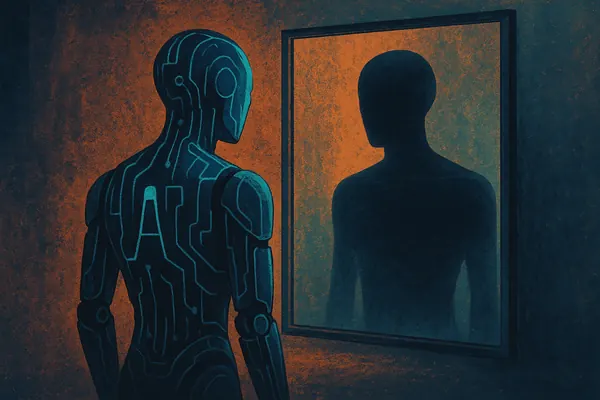
No Reflection in the Machine: Marilyn Manson and AGI Consciousness
A gothic reading of AGI through mirrors, selfhood, and simulacra.
Read post →
Why Hashtai?
The eighth fold, transcending limits, and imagination in AI.
Read post →// Contact
Let’s build intelligent things together.
I’m always open to meaningful conversations around AI engineering, computer vision, Persian language technologies, data science, research, and ambitious product ideas.